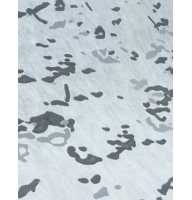
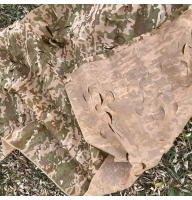
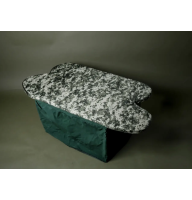
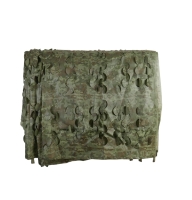
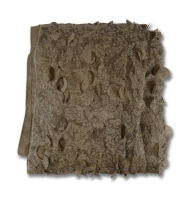
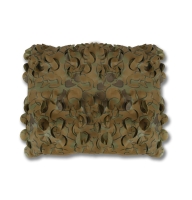
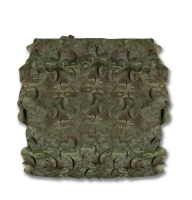
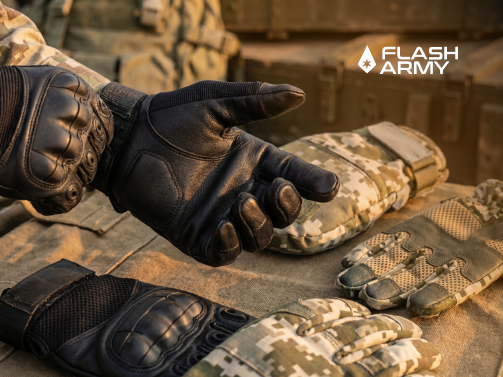
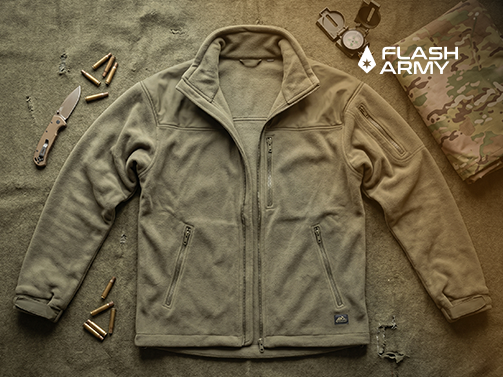
MultiCam emerged as a response to a simple problem: the same unit might operate amid dry grass, dirt, rocks, sparse forest, and urban areas, and clothing matched to one specific environment quickly becomes noticeable once the terrain changes. The pattern was designed for mixed landscapes and varying seasonal conditions, which is why it has no single dominant color. Light sandy, brown, green, and dark sections blend into one another without forming a sharp, distinct patch against soil or vegetation.
The print is just one part of camouflage. Visibility is also affected by lighting, distance, movement, a person's silhouette, the color of their gear, and the specific terrain. If a black backpack, a bright cover, or mismatched camouflage nets are placed next to the uniform, a well-designed fabric print alone won't deliver full results.
The History of MultiCam Camouflage
The MultiCam pattern was developed by American company Crye Precision to reduce a person's contrast against various backgrounds. In 2009, the pattern underwent testing with US forces, and by 2010 it was being issued to units deploying to Afghanistan in place of the standard UCP pattern used at the time.
That experience showed why MultiCam camouflage quickly became so recognizable. It isn't tied to a single type of terrain: on dry ground, its light and brown tones come into play, among grass and shrubs, the green tones take over, and the dark elements break up the smooth outline of a figure. Over time, separate variants for arid, tropical, and snowy environments were developed based on the base pattern. The standard MultiCam is more versatile than narrowly specialized patterns, but it doesn't replace them in sand, dense greenery, or snow.
What MultiCam Is and How It Works
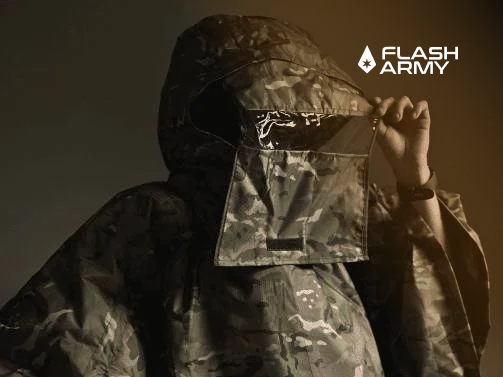
MultiCam is a camouflage pattern made up of varying-scale patches with soft, blurred color transitions. Large light and dark zones reduce the visibility of a silhouette at a distance, while smaller elements keep the fabric from looking like a solid patch up close. The pattern doesn't copy a specific object found in nature — instead, it works with contrast and shape.
It's important to distinguish the pattern itself from the properties of the fabric. The same color scheme can be printed on thin shirting fabric, dense ripstop, Cordura, or polyester for a cover. The print doesn't determine how well an item will hold up to friction, weather, or stress. For field use, what matters is the material composition, density, ripstop reinforcement, and the quality of the stitching and hardware.
Coloring Features and the Camouflage Principle
MultiCam military clothing shouldn't turn into a separate dark or light object against the background. The palette is built so that some colors read more strongly in dry environments, while others stand out more against greener surroundings. On varied terrain, this creates a softer transition between a person and their surroundings than a single-color uniform.
- Patch scale. Large fragments work with the silhouette, while small ones preserve the fabric's non-uniform texture at close range.
- Blurred edges. Sharp geometric boundaries are easier to spot. In MultiCam, the transitions are softer, so the pattern looks less like a regular grid.
- Combination of tones. Sand, brown, olive, and the darker color don't carry equal weight in every section. The balance shifts depending on light and surroundings.
- Material and printing. If a manufacturer claims reduced near-infrared visibility, this needs to be backed by the specific fabric's characteristics. The name of the print alone, without such data, doesn't guarantee this.
Where MultiCam Camouflage Is Used
MultiCam-patterned gear is used for field clothing, headwear, plate carriers, pouches, backpacks, covers, belts, and other equipment. What matters isn't the manufacturer's label, but the consistency of shades and the intended purpose of the items. Pieces with a closely matching palette avoid creating unwanted contrasting patches, but each item still needs to be evaluated on its own characteristics: durability, weight, water resistance, attachment points, and size.
When selecting military gear, it's better to assess it as a complete set. Camouflage won't fix an uncomfortable cut, weak stitching, or unsuitable fabric, and quality clothing won't make up for gear that shines, makes noise, or stands out sharply in color. On Flash Army's product pages, it's useful to compare the MultiCam name, material composition, item format, size chart, and shade photos. This makes it easier to put together a set suited to a specific season and conditions, rather than a collection of items that only match in print.
Special attention should also be paid to how the pattern is applied to the material. Across a uniform, a pouch, and a backpack, MultiCam can vary in tone due to fabric type, print batch, and lighting during photography. This doesn't always indicate a defect, but within a single set, the difference between fabric that's too yellowish, grayish, or dark can be noticeable. For items meant to be used together, it's worth comparing the color name, real photos, material composition, and intended use of each piece. It also matters whether a model has reinforced knees and elbows, compatibility with protective gear, and convenient pocket placement for equipment. All of this affects comfort during extended wear.