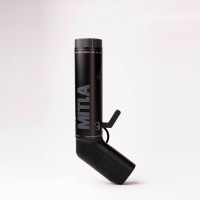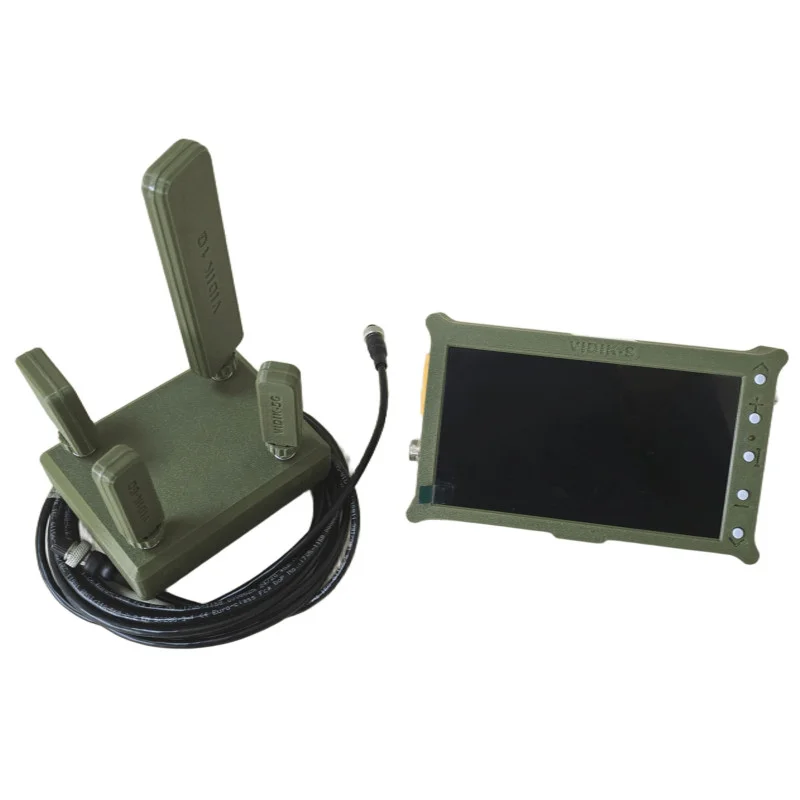
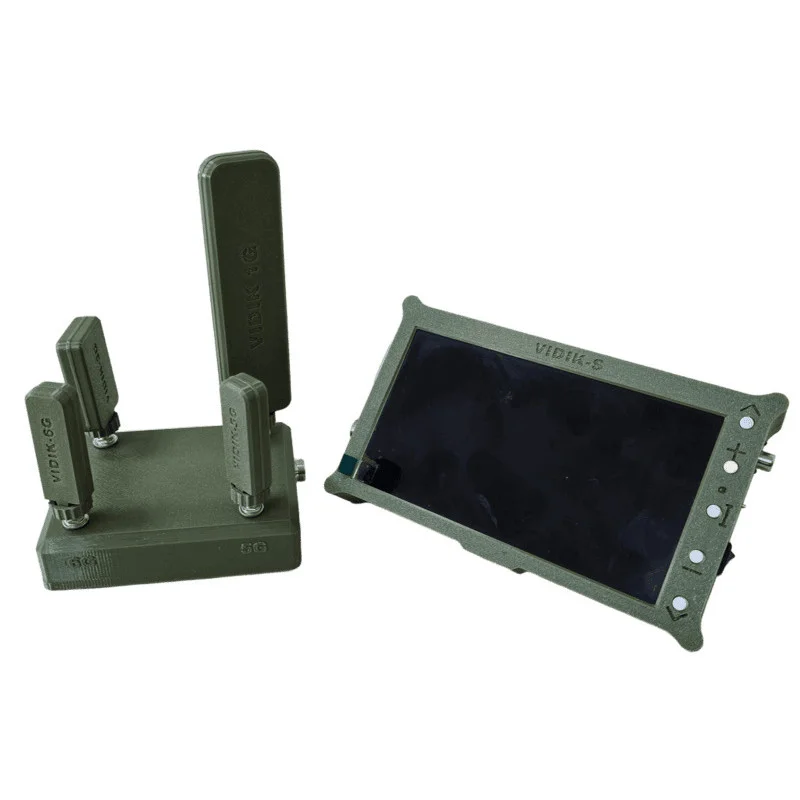
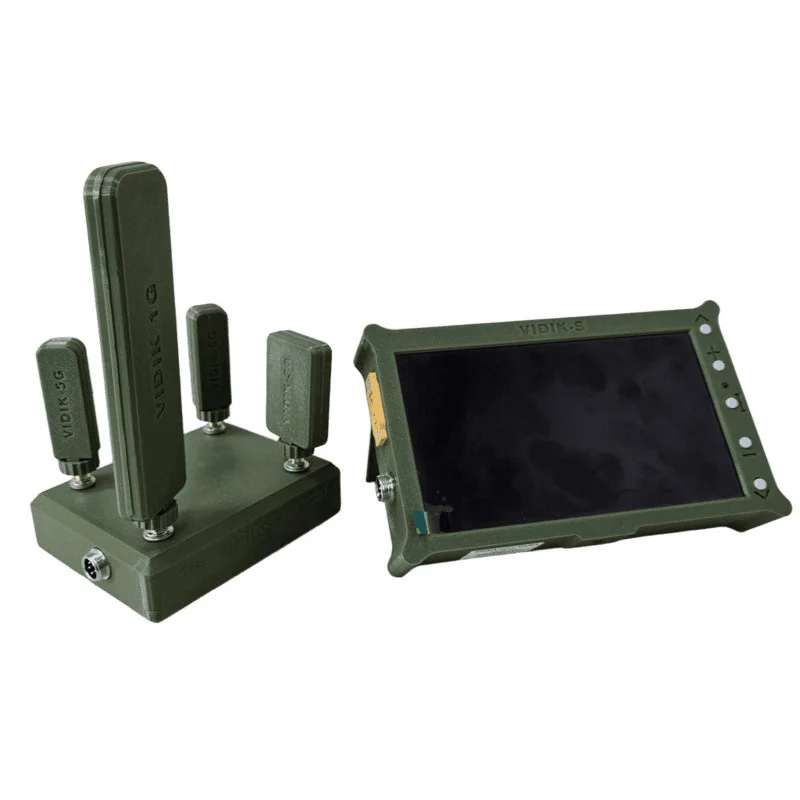
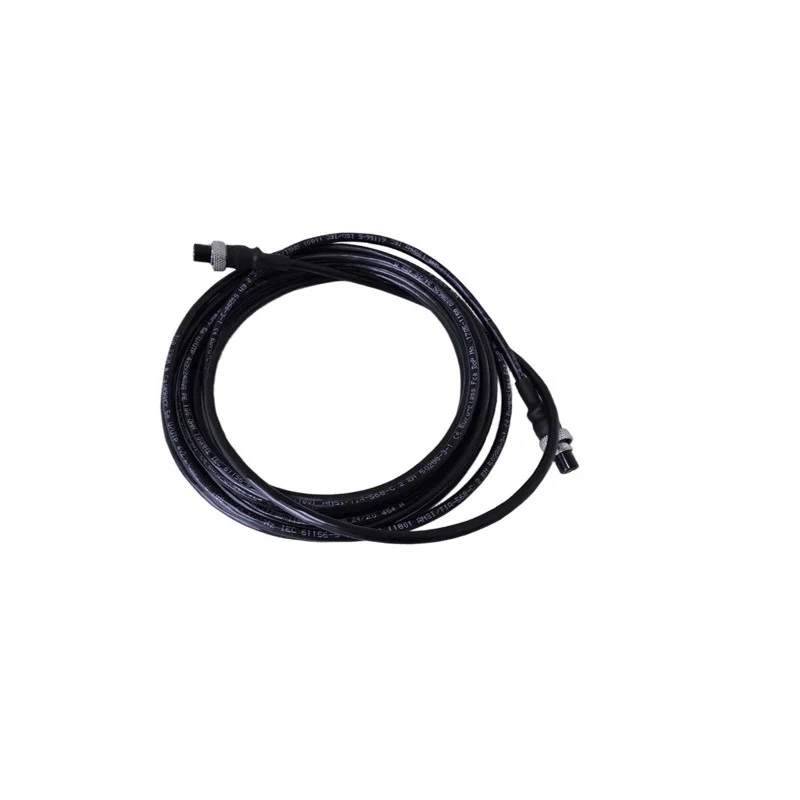
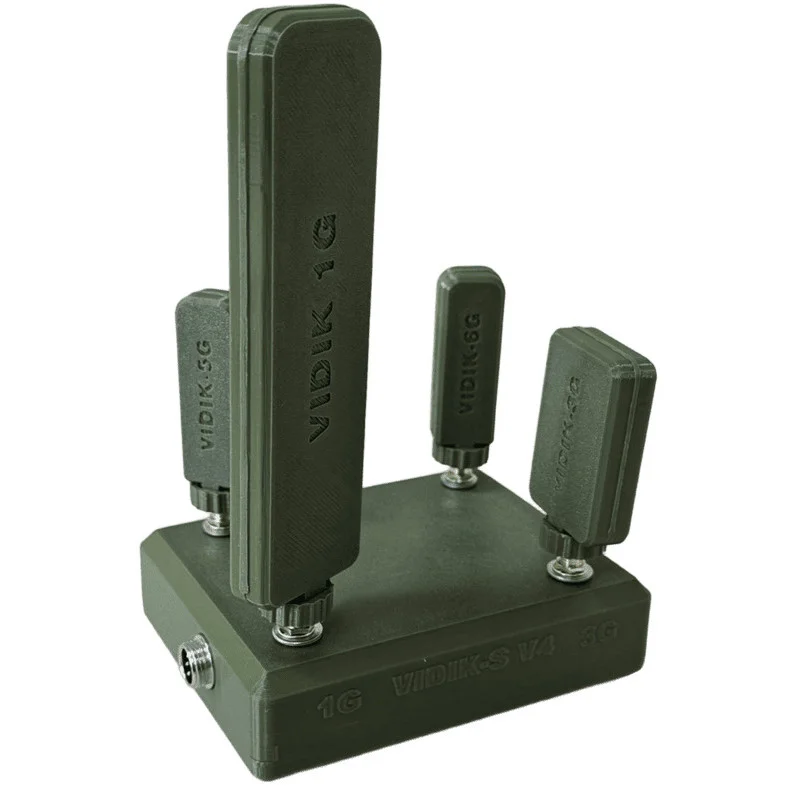
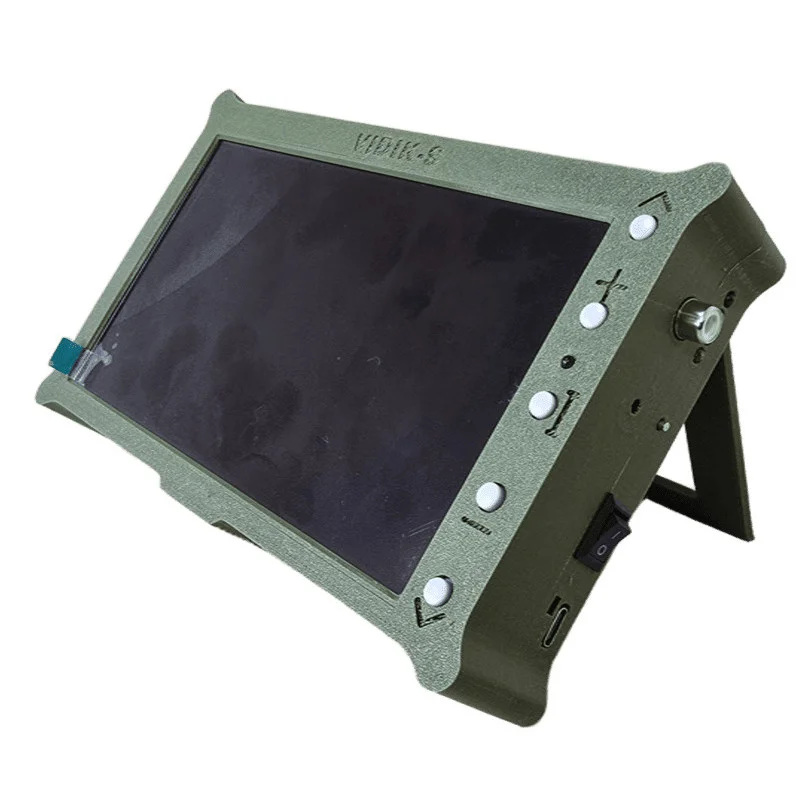






The updated version of the VIDIK-S v4 video interceptor is an updated drone detector with analog video interception capability. It is very easy to use – after turning it on, it automatically searches for video, and immediately displays it on the screen when found. The fourth version of the VIDIK video interceptor has even more modifications (portable, reduced-size body version, stationary). It is used to intercept video signals in the 1.2G range from 850 to 2200 MHz, in the 3.3G range from 2800 to 4150 MHz, in the 5G range from 4850 to 6100 MHz, and in the 6G range from 6000 to 7200 MHz. The updated VIDIK-S v4 model is a version consisting of two blocks (antenna and screen) connected by a twisted pair cable up to 50 meters long. This solution allows the antennas to be moved away from the monitor without any signal loss! This model is highly relevant for armored vehicles, trench use, or observation posts.
VIDIK-S v4 drone detectors for video interception are mass-produced, have successfully passed tests at training grounds by various brigades, and are constantly on duty in real conditions to perform assigned tasks. Our company is ready for cooperation and to fulfill industrial-scale orders. We are constantly working on improving and implementing new functionalities. Attention! The detector cannot intercept digital encoded or encrypted video, for example, from Mavic, Autel, Zala, and other UAVs. This detector is designed to intercept unencrypted analog video signals from FPV drones.
Technical specifications of VIDIK detectors
| VIDIK-P v4 | VIDIK-S v4 | VIDIK-P v3 | VIDIK-S v3 |
| 26 500 UAH | 28 000 UAH | 18 500 UAH | 20 000 UAH |
| Portable version (screen, receivers, antennas in one housing) | Stationary version (screen in one housing and receivers with antennas in another, connection between blocks via twisted pair) | Portable version (screen, receivers, antennas in one housing) | Stationary version (screen in one housing and receivers with antennas in another, connection between blocks via twisted pair) |
| Scans 4 popular bands (1.2 GHz, 3.3 GHz, 5.8 GHz, and 6 GHz) | Scans 4 popular bands (1.2 GHz, 3.3 GHz, 5.8 GHz, and 6 GHz) | Scans 3 popular bands (1.2 GHz, 3.3 GHz, and 5.8 GHz) | Scans 3 popular bands (1.2 GHz, 3.3 GHz, and 5.8 GHz) |
| Scanning frequencies 1.2 = 850-2200 MHz | Scanning frequencies 1.2 = 850-2200 MHz | Scanning frequencies 1.2 = 850-2200 MHz | Scanning frequencies 1.2 = 850-2200 MHz |
| Scanning frequencies 3.3 = 2800-4150 MHz | Scanning frequencies 3.3 = 2800-4150 MHz | Scanning frequencies 3.3 = 2800-4150 MHz | Scanning frequencies 3.3 = 2800-4150 MHz |
| Scanning frequencies 5.8 = 4850-6100 MHz | Scanning frequencies 5.8 = 4850-6100 MHz | Scanning frequencies 5.8 = 4850-6100 MHz | Scanning frequencies 5.8 = 4850-6100 MHz |
| Scanning frequencies 6.0 = 6000-7500 MHz | Scanning frequencies 6.0 = 6000-7500 MHz | Battery capacity - 10000 mAh (4-8 hours) | Battery capacity - 10000 mAh (4-8 hours) |
| Battery capacity - 14000 mAh (6-10 hours) | Battery capacity - 14000 mAh (6-10 hours) | Power supply - 5V/3A type-C | Power supply - 5V/3A type-C |
| Type-C power - has two fast chargers with 5V/9V/12V/20V support | Type-C power - has two fast chargers with 5V/9V/12V/20V support | ||
| External power via XT60 | External power via XT60 |
The VIDIK drone detector is produced in 5 modifications:
Option #1 VIDIK-P v3 – a portable interceptor for 3 bands (1.2 GHz, 3.3 GHz, and 5.8 GHz). Everything is assembled in one housing for portable use. Screen, receivers, antennas, rechargeable battery - all in one convenient housing.
Option #2 VIDIK-S v3 – a stationary interceptor for 3 bands (1.2 GHz, 3.3 GHz, and 5.8 GHz). It has a separate screen from the receiver with antennas, which are connected by a UTP twisted pair cable. This option will be more effective for use in a car, on armor, in a trench, and other similar cases. The uniqueness of this solution lies in the fact that the separation from the screen does not degrade reception or signal quality, due to the fact that the processed signal is transmitted from the receiver to the screen via twisted pair. On the contrary, such a solution positively affects and improves reception and the range of video signal interception in the areas of application specified in this paragraph.
Option #3 VIDIK-P v4 – a portable interceptor for 4 bands (1.2 GHz, 3.3 GHz, 5.8 GHz, 6.0 GHz). Everything is assembled in one housing for portable use. 7-inch screen, receivers, antennas, rechargeable battery - all in one convenient housing.
Option #4 VIDIK-P v4 MINI – a reduced-size portable drone detector with a 5-inch screen for 4 bands (1.2 GHz, 3.3 GHz, 5.8 GHz, 6.0 GHz). Everything is assembled in one housing for portable use. 5-inch screen, receivers, antennas, rechargeable battery - all in one convenient housing.
Option #5 VIDIK-S v4 – a stationary interceptor for 4 bands (1.2 GHz, 3.3 GHz, 5.8 GHz, 6.0 GHz). It has a separate 7-inch screen from the receiver with antennas, which are connected by a UTP twisted pair cable. This option will be more effective for use in a car, on armor, in a trench, and other similar cases. The uniqueness of this solution lies in the fact that the separation from the screen does not degrade reception or signal quality, due to the fact that the processed signal is transmitted from the receiver to the screen via twisted pair. On the contrary, such a solution positively affects and improves reception and the range of video signal interception in the areas of application specified in this paragraph.
For information on which P or S video detector option to choose:
Connecting the antenna and receiver with a coaxial cable leads to signal loss. For example, with an RG-58 cable in the 5G band over a length of 10 meters, signal losses will be approximately 17 dB, including connectors, meaning the signal at the antenna itself will be 7 times better than through a coaxial cable. If using an RG-8 cable, the signal losses in this band and at this frequency will be approximately 7 dB, including connectors, meaning the signal will be 2.2 times worse. What if the antenna needs to be extended by 30 or even 50 meters? Even the use of LNA amplifiers can only partially compensate for the lost signal, because it amplifies the useful signal and adds its own extraneous noise. If you plan to separate the antennas from the receiver, we recommend ordering the VIDIK S model.
Principle of operation of the VIDIK drone detector:
After turning on, the detector automatically starts scanning the airwaves by frequency with a 2 MHz step and searching for a video signal; no buttons need to be pressed to start scanning. Scanning proceeds automatically across all frequency bands simultaneously! The screen does not light up during this time; a blinking red LED on the front panel indicates that the video detector is searching. If VIDIK intercepts a video signal from a drone, it automatically stops on that video, the screen instantly turns on, emits an audible signal, and the red LED remains constantly lit. To turn off the sound, press button I; the audible signal will sound again on the intercepted video during the next scan. The intercepted frequency at which the video was found is displayed in the upper left corner of the screen, and the RSSI signal level is displayed at the top center of the screen; the higher the number, the stronger the signal level. If you wish to skip a found video during scanning, for example, video from your own drone or if the detector stops on a frequency by mistake, you need to press button I for 10 seconds, and "Ignore" with that frequency will appear on the screen. If you wish to continue scanning, press the up or down button. The difference in buttons is that pressing up will scan in increasing frequency and loop back, while pressing down will scan in decreasing frequency and loop back. The full scan cycle takes approximately 15-20 seconds. Video signal scanning is performed by frequency with a 2 MHz step, not by channels. The + and - buttons are used for fine-tuning the frequency with a 2 MHz step. While video is displayed on the screen, the detector does not scan for subsequent videos on other frequencies. It is advisable to periodically switch to scanning mode to find new video interceptions.
Detection and video interception range:
This is a very common and widespread question, but there can be no single answer. We can only provide statistics based on the average feedback from our users. Why is there no answer to this question?
The video signal interception range depends on the following conditions:
- What is the power of the transmitter to be intercepted?
- What is the operating frequency band (1.2 GHz, 3.3 GHz, 5.8 GHz)?
- What is the drone's flight altitude?
- What is the terrain?
- What is the radio wave propagation?
Of course, no one knows these conditions in advance, so it is incorrect to give precise distances to avoid confusing users. Here are a few examples that our team actually obtained at training grounds:
- Transmitter power was 2 W
- Operating frequency in the 5.8 GHz band
- Drone flight altitude was 200-300 meters from the ground
- Terrain - flat
- Radio wave propagation - a normal sunny day.
Under these conditions, the interception distance was 4000-6500 meters.
The maximum feedback from users was as follows - at 1.2 GHz, they intercepted at 15-25 km; there were situations when, with a directional antenna, a stable video signal was received at a distance of 25-35 km at 3.3 GHz. Of course, the transmitter power in these situations is unknown to anyone.
The product price does not include delivery cost; when sending the detector via "Nova Poshta" LLC, the order is insured for its full value!
There are no reviews for this product, be the first to leave your review.
No questions about this product, be the first and ask your question.