

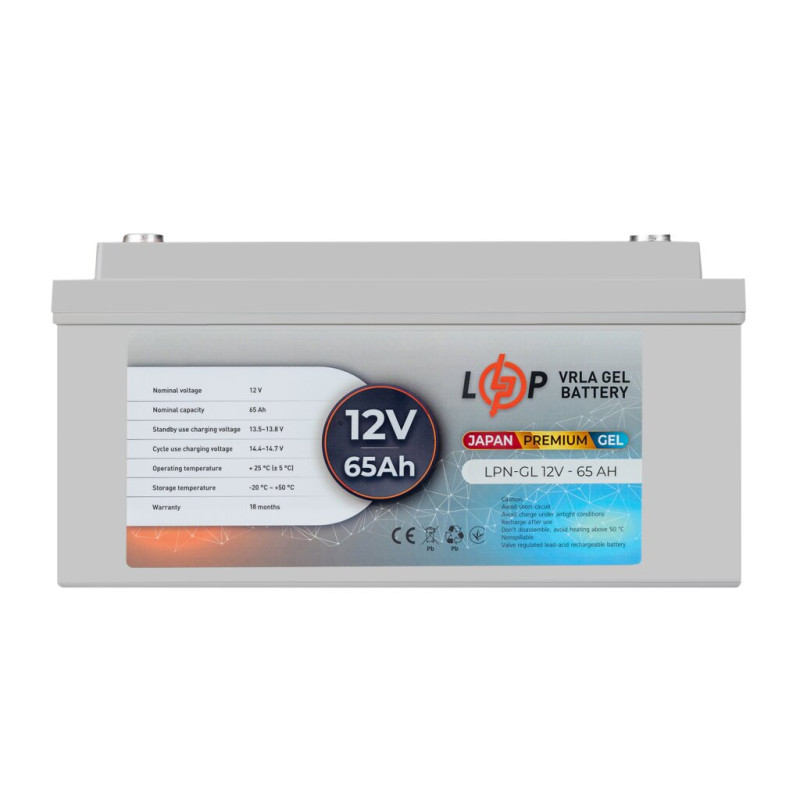
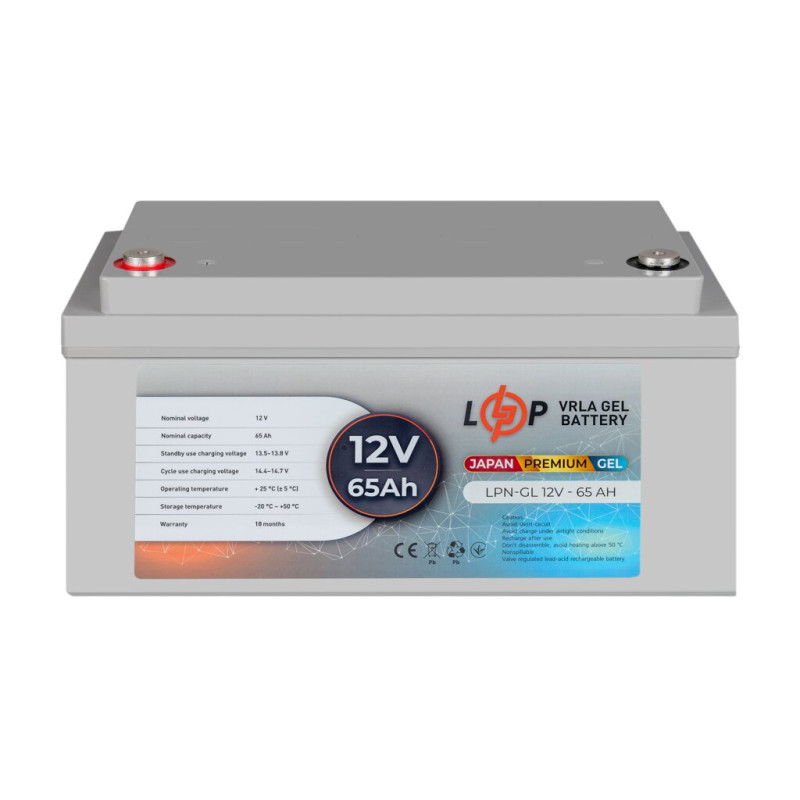
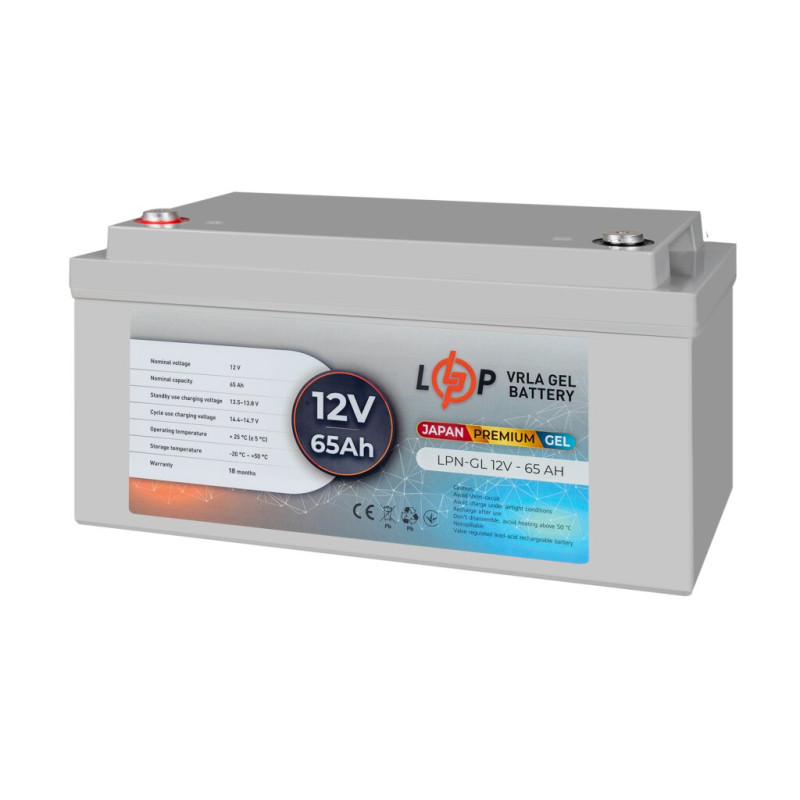
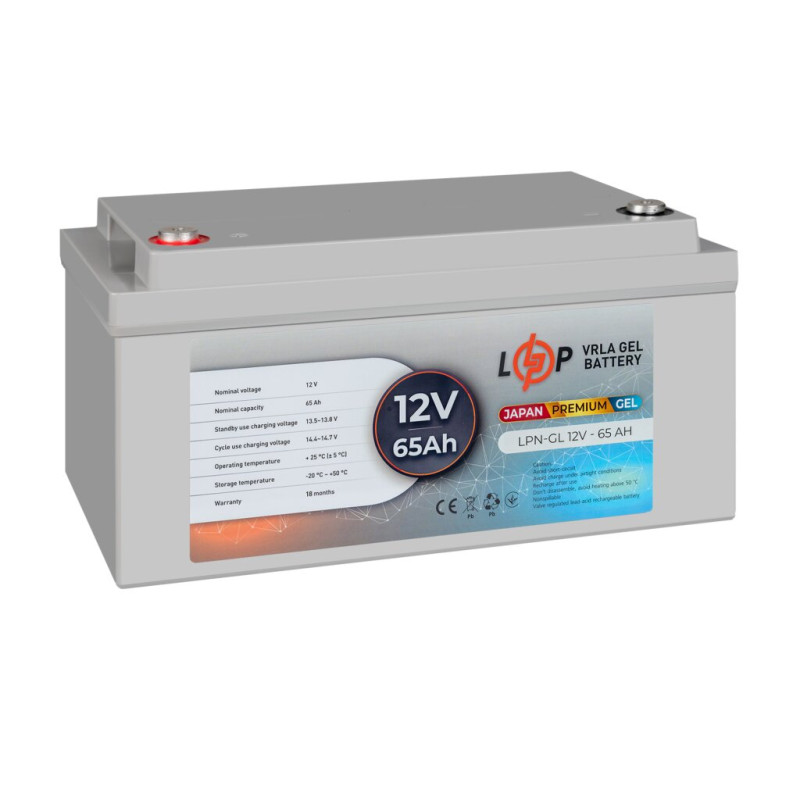
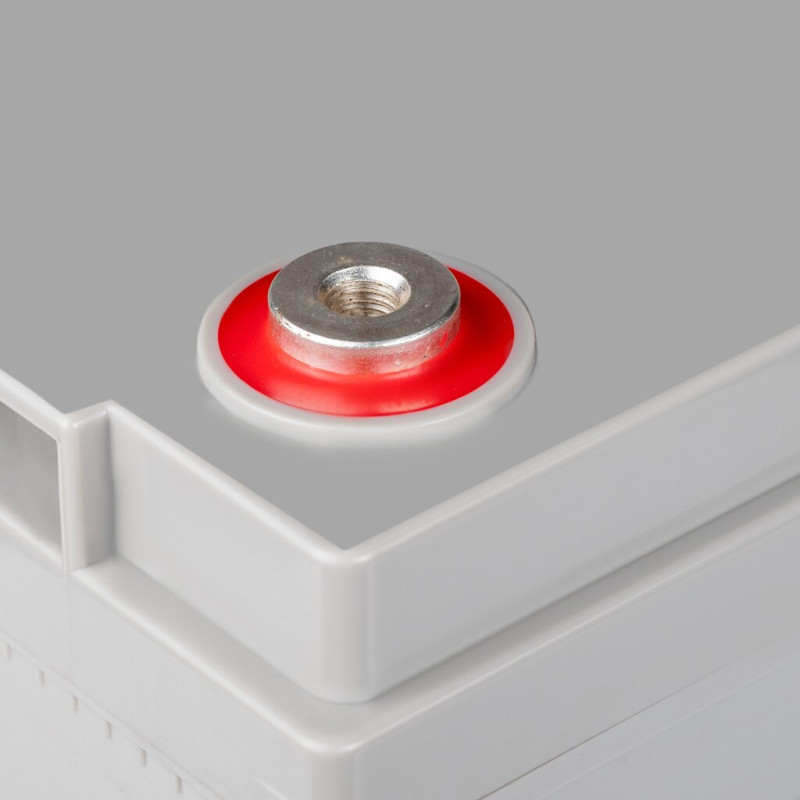






A GEL (gel-cell) rechargeable battery is a completely sealed power source that requires no maintenance during storage and operation.
Considering the advantages and disadvantages of a gel battery, it can be concluded that GEL-type batteries significantly outperform conventional lead-acid batteries in terms of technical and operational characteristics.
Advantages of a gel battery:
- High cycle life (1500*) and, as a result, longer service life (on average 7-8 years, depending on operating conditions).
- The battery can be installed in residential premises. The viscous electrolyte structure and complete sealing of the casing prevent acid leakage and guarantee the absence of harmful fumes.
- In practical use, gel batteries show stable results when operating in low (-20°C) and high (+50°C) ambient temperatures. The wide range of operating temperatures allows GEL batteries to be used as power sources for solar power stations.
- The manufacturing technology of GEL batteries implies their ability to withstand prolonged discharge, cyclic discharge, deep discharge, and high-current discharge.
- Batteries of this type have low self-discharge rates during long-term storage and reliable self-protection against over-discharge and over-charge.
Features of gel battery production
The main feature of gel batteries is the viscous (gel-like) structure of the electrolyte.
The casing is filled with electrolyte using a vacuum pump, which ensures its uniform concentration and high density of contact with the plates.
The separators dividing the lead electrodes of gel batteries are made of a durable microporous material with aluminum additives. This design makes the separator resistant to vibrations and mechanical damage, as well as to chemical effects of the aggressive acid environment inside the battery.
After filling with electrolyte, the battery undergoes prolonged drying, during which microcracks form in the electrolyte structure. This technology allows for a several-fold reduction in the percentage of evaporating fumes.
Rechargeable batteries manufactured using GEL technology, compared to AGM batteries with a similar electrolyte volume, have:
- higher capacity,
- consistently homogeneous reaction on all parts of the plate,
- less plate corrosion,
- high heat dissipation,
- minimal electrolyte stratification.
What is a gel battery for?
Universal external gel-type batteries are used:
- In telecommunication and other communication systems.
- For equipment in video surveillance, security, burglar, fire, and other alarm systems.
- In uninterruptible power supply systems for server stations.
- As a power source for medical, laboratory, commercial, and other specialized equipment.
- In energy storage systems from alternative sources (batteries for solar panels).
- To provide autonomous or emergency lighting.
- As batteries for uninterruptible power supply units and UPS.
Which batteries are best for solar panels, and which battery should you buy for a UPS?
The choice of battery for a solar power system depends on the generation volumes of the solar power station, as well as on the required amount of electricity to ensure consumption.
An AGM or gel battery for a solar panel must have a sufficient capacity reserve, a wide range of operating temperatures, and a long service life.
Before deciding which battery is best to buy for a UPS, carefully study the parameters of the uninterruptible power supply and determine the amount of time required for autonomous operation of electrical equipment.
Gel batteries are in high demand among consumers who purchase backup power kits for heating boilers, emergency lighting systems, or autonomous water supply.
Before buying batteries for solar panels, uninterruptible power supplies, or other purposes, consult a specialist:
How to avoid battery capacity loss in conditions of frequent power outages?
Two important rules for caring for AGM, GEL, MG batteries:
- Do not frequently discharge the battery by more than 30% of its capacity (consider this when calculating battery capacity)
- After discharge, the battery must be fully charged with a current of 1/10 of the capacity for 10 hours
IMPORTANT! If a group of several batteries connected in parallel or in series is used, then:
- all batteries must have the same capacity,
- be of the same type (AGM, GEL, or MG),
- have the same voltage, the same number of charge/discharge cycles,
- be from the same batch of the same brand.
Violation of these requirements leads to premature failure of one or more batteries and is not a warranty case. More detailed information can be found in our article.
There are no reviews for this product, be the first to leave your review.
No questions about this product, be the first and ask your question.