
Servos for drones


What is a drone servo?
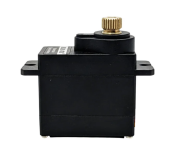
A drone servo is a compact actuator that moves a mechanism to a specified position and holds it within the allowable load limit. Inside a positional servo, there is typically an electric motor, a gearbox, a position sensor, and a control board. In FPV drones, such actuators are used in assemblies that require controlled rotation, opening, or fixation of a mechanism.
What is a drone servo used for?
A servo can turn a lever, operate a valve, change the position of a separate assembly, or actuate a release mechanism. For example, drone drop systems often use a servo that, upon command, turns a lever and opens the latch. For such an assembly, torque, rotation angle, and the allowable load on the actuator are crucial.
How does a drone servo work?
The servo board receives a control signal from the receiver or flight controller and compares the command with the actual position of the output shaft. The motor turns the shaft via the gearbox, while the position sensor provides feedback and helps stop the mechanism at the desired point.
This is how a servo differs from assemblies where drone motors continuously spin propellers to generate thrust. A positional servo controls the position of a mechanism, whereas a motor with a propeller is designed for continuous rotation.
Characteristics of drone servos
- Torque — indicates the rotational force generated by the servo. The allowable load also depends on the lever arm length. Stall torque should not be regarded as a continuously allowable load. Its value must also be verified against the voltage at which the measurements were taken.
- Speed — usually specified in seconds per 60° rotation at a given voltage. Actual movement depends on the load and power supply.
- Operating voltage — must match the permissible range of the servo. If necessary, a separate voltage regulator or BEC is used.
- Current — increases during startup, under load, and when the shaft is stalled. The power source is checked against the maximum consumption.
- Gearbox — plastic gears are lighter, while metal ones generally withstand higher loads better, but add weight. Backlash and build quality also affect accuracy.
Types of drone servos
Analog and digital servos differ in how they process the control signal and control the motor. Digital electronics generally provide faster response and more stable position holding, but may draw more current. Exact parameters should be checked for the specific model.
In terms of dimensions, there are micro, mini, and standard servos. For moving assemblies where drone cameras are installed, the casing weight and gear backlash are also important. Continuous rotation servos are also available separately, where the command sets the direction and speed rather than a fixed angle.
Recommendations for choosing drone servos
First, determine the load, lever arm length, and required movement angle. Next, check the torque, speed, voltage, maximum current, weight, and casing dimensions.
For control via FPV transmitters, a separate channel is allocated, and a switch or other control element is assigned to it. The receiver or flight controller must then generate a signal compatible with the servo.
Where to buy a drone servo?
If you need a servo, buying it based solely on casing size will not work. A lightweight pivot assembly and a higher-load mechanism require servos with different torque and speed values. The maximum current that the power source must supply also depends on the actuator's characteristics.
Before ordering on the Flash Army website, you need to determine the operating voltage, control signal type, dimensions, lever arm length, and load nature. Based on these parameters, you can select a servo for a specific mechanism.